3.12.2008

cephalopod camouflage

I've got some really cool stuff to show you. (This time there's video!)

So, while chameleons are well-known for their ability to change the color of their skin, they don't actually do it to camouflage themselves. Each species of chameleon is naturally colored to match their surroundings, and they really only change colors to send signals to other creatures, such as their mood or their physiological state.

Cephalopods, on the other hand, have much more advanced control over their coloration, in addition to the texture of their skin. Members of the clade Cephalopoda, particularly those in the clade Coleoidea, include octopuses (yes, octopuses), squid, and cuttlefish. Members of this clade have intellects far superior to any other invertebrates', which aids in their use of camouflage.

Octopuses, considered the smartest of invertebrates, are able to change both the texture and the color of their skin, through direct neural control of the muscles connected to pigment sacs called chromatophores.
A cephalopod chromatophore
(© www.tolweb.org)

The chromatophore is one of many small organs just under the skin, with a sac called the cytoelastic sacculus, which contains tiny pigment granules. Relaxed, the compressed sacculus is opaque, hiding the pigment granules. When the muscles surrounding the sac contract, the membrane of the sacculus stretches out (with as much as 50 times the area of its relaxed state) to expose the color of the pigment within. The skin of the cephalopod contains millons of these chromatophores, containing red, yellow, orange, brown, and/or black pigments, allowing the creature to take on as many as 50 different appearances, and change its coloration very rapidly. They also have leucophores, which display white spots, and iridiophores, which refract light and make the animal seem luminescent. All of these changes in color, in addition to the shape-shifting ability, allow it to camouflage or communicate very effectively.

A cephalopod can take in the nature of its surroundings using its highly complex eyes (cuttlefish have W-shaped pupils and two foveas, for acuity looking both forward and backward), and feel and smell the things it touches with its suckered tentacles. Here, an octopus effectively mimics its surroundings, and when threatened, displays its aggressive white color (notice how the white ring around the eye makes it look bigger and more intimidating):

(© Roger T. Hanlon, Marine Biological Laboratory, Woods Hole, MA)

Here are some other examples of octopuses adapting to the colors and textures of their environments:

(© National Geographic)


(© Hanlon)

Also in Coleoidea are the squid, some of which can also change the patterns of their skin. In the case below, when two males fight, they display aggressive white spots. When a male is courting a female, however, he shows his attractive brown shade. He can also split his coloration, however, to show the sexy brown side to the female, while his other half displays the aggressive white to fend off any other males in the area. Even cooler is that when she swims to the other side of him, he instantly switches the pattern, so she only sees his non-aggressive coloration:


(© Hanlon)

The third clade in Coleoidea are the cuttlefish, who have similar abilities to change the pigmentation and texture of their skin. Some species display bright coloration to show off to the ladies or to ward off predators, while others do their absolute best to blend in:


(© Hanlon)

One of the most fascinating things they can do is display moving bands of coloration on their skin, making it appear as if rays of light are moving across their bodies. I think the only other place I've seen this is on a space ship in Star Trek (yes this is real):


(© NG)

Here's some more fascinating video from PBS' NOVA series, with guest Mark Norman, marine biologist and curator of Museum Victoria in Australia (sound on):


(© NOVA/WGBH)

(side note: British people and their colonies say Cephalopod with a "kef" instead of "sef" like we Americans.... they still ain't figured out all of the English language yet)

(© NOVA/WGBH)

When the Giant cuttlefish of Australia come together to breed, the biggest, toughest males engage in intrasexual selection, where the most impressive guy wins. They always put on a dazzling show as they duke it out for mating rights (whether or not the females actually care):


(© NOVA/WGBH)
The little guys can't compete with the machismo of the larger, stronger males, so they've developed a new tactic to get to the waiting females: pretend to be one. In an amazing display of invertebrate guile, smaller male cuttlefish will change their body size and shape to match that of a female, and slip past the fighting males:


(© NOVA/WGBH)

And finally, the Flamboyant cuttlefish, the only one known to walk around on its legs, shows a bright and complex pattern when threatened to demonstrate to predators that it is poisonous to eat (also look at these):


(© NOVA/WGBH)

These cephalopods have developed complex systems of visual and tactile information-
gathering, and have the brains and skin to match, making them some of the most impressive marine invertebrates in the world. With advanced nervous systems capable of learning and problem-solving, eyesight that rivals that of the great apes, and a system of skin control that suits any environment, they are no doubt easily comparable to some of the most advanced predators that walk on land. Without, of course, the limitations of a skeleton:


(James B. Wood, Bermuda Institute of Ocean Sciences)


Paddy


2.05.2008

mars in 3D!

This is Olympus Mons.
As far as we know, it's the largest mountain--and volcano--in the solar system. At 27,000 m (88,500 ft) high, this BAMF of igneous rock is more than three times the height from sea level of Mount Everest, and more than two and a half times taller than Mauna Kea. On Earth, it would reach well into the stratosphere. The caldera at its summit is about 85 km (53 mi) long by 60 km (37 mi) wide, and up to 3 km (1.8 mi) deep.

And now, you can check it out in 3D.

On Tuesday, the European Space Agency published photos from the Mars Express, an orbiting satellite carrying the High Resolution Stereo Camera (HRSC), which has been taking 3D pictures of the planet's surface for the past three years. Until now, images of Mars have only come from 2D cameras either orbiting or on the surface, and so scientists have had little information on the true contours of the terrain. From these new pictures, the ESA was able to produce a Digital Terrain Model, or topographical playground, to give some perspective (literally) on the proportions of things on the Red Planet.

If you want to learn more about how they obtained the pictures, check out the ESA's website on the Mars Express HRSC. One of the best places to go walk around Mars and get pictures like this one is through the HRSC page presented by the Planetology and Remote Sensing Department, Institute of Geosciences, Freie Universität, Berlin. For tips on navigating around the maps, hit up the "How to use HRSCview" in the left hand navigation.

Paddy

1.17.2008

save the whales! from the navy!

No, they're not being hunted with torpedoes. But whales, dolphins, and all other marine mammals are in serious danger from the onslaught of another of the Navy's deadly tools: SONAR [caps for an acronym, not sensationalism].

As a species, Homo sapiens is characterized by the abilities to make tools and conduct complex communication. It is these attributes that have set us apart from all others on this planet, not because we're any better or more important than any other species, but because we have the greatest impact on all living things and the physical planet itself. Short of the evolution of oxygen-producing cyanobacteria billions of years ago that created the livable atmosphere, no other species has had such a large influence on the existence of so many other organisms.

As time progresses, the communication and tool-building abilities of the human species becomes increasingly complex, and from the days we started with the bludgeon and the cutting tool thousands of years ago, we have arrived at the advent of such things as the MacBook Air and Ununoctium (slightly different technology, I know). Essentially unchecked until recently, however, have been the effects of our creations and their byproducts on the atmosphere, land, and seas.

Ironically, one of our more advanced tools, one that is causing very damaging effects to other species, was adopted from them almost a century ago.

The members of the clade Cetacea, which includes whales, dolphins, and porpoises, live exclusively in the water, and hence have evolved special mechanisms of communication and hearing that work exceptionally well in that environment. Since water is a much better medium for transmission of sound than is air, cetacean ears are quite different from those of terrestrial mammals. In their evolution from land mammals, whales and other cetaceans have lost all external auditory anatomy, and have developed much more powerful internal ears, capable of sensing the direction of sounds up to tens of miles away. Some cetaceans, the odontoceti (toothed whales) also have developed an adaptation called echolocation, similar to that used by bats, some shrews, and cave-dwelling oilbirds.


The dolphin, for example, makes a series of rapid clicking noises (up to 600 per second!) by passing air through phonic lips, located just inside the blowhole. Sounds are transmitted through the dolphin's head, reflect off of bones in the skull, and are focused and modified by the varying-density lipids in the melon. These clicks are broadcast outward, and some sound waves are reflected off of objects in the water and return to the dolphin. The dolphin then receives the reflected waves through its jaw bone, which transmits the signal to the inner ear. The brain then processes the clicks (at 600/second) to determine the location, size, shape, trajectory, and density of the reflecting object. It is with these abilities that toothed whales can successfully navigate and hunt in low-visibility waters.


Through our advanced tool-making and communication abilities, humans have figured out how to replicate this adaptation with modern technology, called SONAR, short for SOund NAvigation and Ranging. There are two kinds: active and passive. Passive sonar consists of listening in the water to the sounds generated by other things. Active sonar works in a similar fashion to that of the dolphin's, by sending out sound waves to be reflected and returned. This is the "ping" that you often hear in movies with submarines (although modern submarines don't use active sonar very often any more because it can easily give away your position).

The first modern echolocation device was patented a month after the Titanic sank in 1912, and a similar device was demonstrated to detect the presence of icebergs up to 3 km away. Sonar technology has remained relatively consistent over the past century, with developments only in the use of computers and the power of listening devices.

Both active and passive sonar are commonly found in warships, submarines, and airplanes, and active sonar is used in some torpedoes. It's also common in fish-finders on personal and commercial fishing boats, and has several scientific uses, such as ocean-floor mapping.

The United States Navy continues to run trials and experiments with active sonar, with the goal of advancing threat-detecting abilities, using high-powered arrays with frequencies of 3-8 kHz and volumes up to 235 decibels. For comparison [PDF], standing one foot away from a jet engine as it's taking off is 180 decibels, which causes immediate inner ear tissue death, and a sonic boom, the loudest sound possible in air, is around 200 db.

Not surprisingly, with the use of these powerful sounds, the nearby marine life is being negatively affected. On several occasions, mass beachings of whales have been reported after sonar exercises in the Bahamas, Greece, and the Canary Islands and the Madeiras in the Eastern Atlantic. The stranded whales have been found with ears and eyes bleeding, and on necropsy of the heads of several after a 2000 Navy exercise in the Bahamas, scientists found massive hemorrhaging around the ears and brain due to severe sonic trauma. After a NATO test in 2002, another mass stranding of rare beaked whales gave scientists an opportunity to dissect whole whales, wherein they found the same brain hemorrhaging, but also bleeding of the vessels surrounding the liver, kidneys, and other internal organs, in addition to gas and fat bubbles, similar to "the bends." Based on this evidence, it would appear that, after being subjected to organ-crushing blasts of sound, the disoriented whales shot to the surface to try to escape the noise, incurring fatal air and fat emboli in the bloodstream.

The Navy, when confronted with this information, has consistently denied responsibility, and has been uncooperative with efforts by environmental and non-governmental panels to work toward a solution. Also problematic is the fact that a large percentage of marine mammal research in the United States is funded by the Navy, and so scientists aware of the damage being done have remained largely silent for fear of losing their funding.

In March of last year, the NRDC filed a lawsuit against the Navy to keep them from conducting dangerous sonar exercises off of the coast of southern California. In November, a US District Court judge in Los Angeles ruled that the Navy had not conducted sufficient environmental impact investigations, and ordered them to do so.

On January 16th, President Bush issued a special exemption to the Navy from provisions of the Coastal Zone Management Act, and the White House Council on Environmental Quality gave the Navy a waiver from the National Environmental Protection Act, effectively reversing the judge's ruling. The Navy is expected to resume their sonar testing activities, while lawyers for the NRDC are struggling to challenge the exemption.

Here's a dramatic yet motivating video by the NRDC on the effects of sonar on the whale populations around the world, and this is an article in the NRDC's OnEarth Magazine that provides some more information on the history and effects of sonar.

Keep tabs on this story, and to show your support you can visit the NRDC's Action Center, where you can learn about the many ways you can help them defend the environment.

Paddy

12.02.2007

the praying mantis

This is a California Mantis, Stagmomantis californica. Being a Maine boy, I didn't know they lived out here, or much about them, until I did a little research.

This is actually just one member of the clade Mantodea, which contains around 2,000 species, about 20 of which live in the US. Mantids are probably best known for their
body morphology, from which their name is derived ("Praying" refers to the position of the front legs, and "mantis" is the Greek word for "prophet"), but also the fact that they are sexually cannibalistic.

Mantids have a long, slender body with large forelegs, modified into giant pincers that are good at catching and holding prey, which can include insects and arachnids, but also small reptiles, birds, and mammals [cautionary heads up to those who like mice more than insects]. These, along with the ability to swivel their heads 180˚ (exceptional in the insect world) make them excellent predators.


Insects in general are fascinating creatures, mostly because of their prevalence (there are over a million cataloged species, more than double the total number of other species on the planet, with likely 5-9 million more that we don't know about), their resilience (terrestrial insects have been around since the Devonian period, about 407 million years ago), and their adaptability (they come in all sorts of shapes and sizes, and have some amazing environmental adaptations (like this moth on cement). Mantids can have the same camouflaging coloration, which helps them hide from predators, but also from prey, for the element of surprise, like this one, on a gum tree:

or these Ghost mantids:


Like all arthropods, mantids' growth is marked by a molting cycle, and they grow into and shed an exoskeleton several times during their lifetime, which is about 10-12 months. Some can have large wings, but are usually only used by the males in searching for female mates during the mating season. The one on my shoulder appears to be a female, because her wings extend only part-way down her abdomen, (males' wings extend beyond the end), and her larger cerci.


Speaking of sex, the praying mantis is also notorious for its kinky sexual practices. In an interesting evolutionary twist, during or immediately post-copulation, the female mantis will turn around and start eating the male, as a high-energy snack for the developing "buns in the oven." Check this out:


In most species, the males like to survive a sexual encounter so that they can go on to knock up more females and get as much of their genetic information into the pool as possible. However, in this case the male is offed after his first time, and his body contributes to the health of his young. His offspring still benefit, so it's not all bad.

The praying mantis is a fascinating example of a product of evolution, and these capable predators can be found all over the world, often in your back yard, or in my case, neighborhood park.

Paddy

(images from Wikipedia, video from YouTube)

11.17.2007

the great pacific garbage patch

The other day, I was at the Green Festival in San Francisco, and I overheard someone talking about a giant island of plastic in the Pacific ocean, "Twice the size of Texas."

I'd heard a few things about it, but didn't know much, so I thought I'd look into it. Turns out that it may or may not be the size of two Texases, as no one's got an official measure, but it sounds huge. And deadly.

The Earth, as some of you may know, is round, and spinning. Because of factors such as solar heating, the shape of land masses and the inertia of water, several large, perpetual currents exist in our oceans, and their existence has a strong influence on things such as weather, water temperature, migratory routes, and human trade and military activity.


(http://blue.utb.edu/paullgj/geog3333/lectures/oceancurrents-1.gif)

As you can see, what's created are essentially giant eddies, circular water flows with relatively stationary centers. One in particular is the North Pacific Subtropical Gyre (we'll call it the NPSG), with an area of approximately 10 million square miles.

The currents of the ocean can have a profound effect on the atmosphere above, as the temperature and flow of water can affect ambient air temperature, humidity, wind, and precipitation. The NPSG is no exception. The center of this gyre is also known as the "horse latitudes," because shipping vessels hundreds of years ago would run into dead air and wouldn't be able to fill their sails. After weeks sitting in the same place, they would end up dumping their livestock, including horses, into the water, in an attempt to lighten the load and move along. Must've been good eats for the sharks.

(Edit: Another, more verifiable etymology for the name "horse latitudes" is from an old tradition of throwing a straw-stuffed effigy of a horse off the side of the ship in celebration of a sailor's having worked off a debt to the ship's paymaster. Since these debts were frequently worked off halfway across the ocean, this became the place for the practice. How interesting that the practice of dumping things in the middle of the ocean continues to this day...)

Turns out, the same current and weather patterns that trapped ships long ago is now having the same effect on human wastes. Over the last few decades, a giant mass has been accumulating at the center of this vortex, composed of trash generated by oceangoing ships, runoff from terrestrial storms, broken fishing nets, and lost cargo from big storms. One of the most dangerous components of this flotilla of flotsam is the large amount of plastic.

Plastics, including polyethylene and polypropylene, are synthetic polymers that have remarkable strength, flexibility, and durability. They're used extensively in every aspect of modern civilization, from cars to medical devices to naughty toys. It is their durability, however, that causes the problem.

Instead of being biodegradable, plastics are photodegradable. This means that instead of being broken down by biotic processes such as bacteria, they are broken down by exposure to light, particularly from the sun. The other critical difference is that, where biodegradable substances are returned to the life cycle in the form of natural chemicals, photodegradable plastics are just broken down into smaller and smaller pieces, creating a large volume of molecular-sized synthetic polymers.

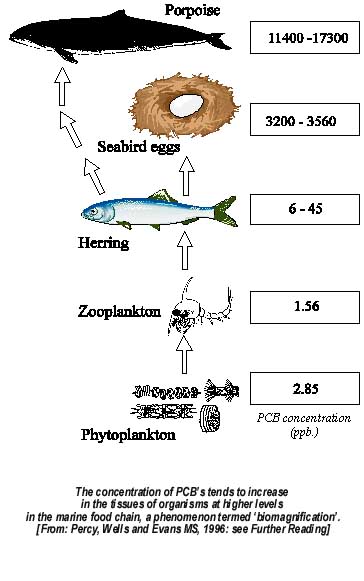
One of the chemical properties of these polymers is that they absorb and give off different chemicals, some of which are nonylphenols, PCBs, and the infamous DDT. When plastic in the ocean is eaten by living organisms, the toxic chemicals within are released into that organism. In phytoplankton, toxic chemicals are consumed and then passed long the food chain up to higher trophic levels, and the concentration of these chemicals increases exponentially at each level, in a process called biomagnification.


(http://www.bofep.org/Publications/Fundy%20issues/biomagnification.jpg)

Following the diagram above, replace the porpoise with a person, and consider how people are truly integrated in the global ecosystem.

The amplification of these toxins can have profound effects on higher organisms. In the case of DDT, the accumulation in birds makes their shells weaker, and so, when attempting to incubate their prospective young, the parent birds inadvertently crush the eggs, destroying any hope of a subsequent generation.

Also perilous for those birds, such as this late albatross, small plastic objects look like food, but lack the same nutrients:


(http://www.tripdance.org/IMAGES%20Web/Poisoning%20the%20Well/Sea-Plastic-LN-PG5oct05a.jpg)

Due to the nature of its currents, the NPSG has been collecting and consolidating in its center vast quantities of these non-biodegradable plastics, which in turn have been able to amass and release large amounts of toxic substances into the oceans and the food web. Scientists have named this area "The Great Pacific Garbage Patch," and have been researching it with greater interest. With time, we'll be able to figure out exactly how big it is, and hopefully figure out a way to clean it up.

But is it an island? As it turns out, no. It's actually worse than that. Instead of being a giant floating island of plastic trash, the center of the NPSG is actually more like a dilute soup of plastic pieces big and small, intermixed with all of the living phytoplankton and zooplankton. This makes it that much more difficult for plankton-grazers to get nutritious food without picking up little pieces of plastic. It also means that it's that much more difficult for us to figure out how to get the plastic out of the ocean without taking out tons of marine life as well.

One of the best resources on all of this is the Algalita Marine Research Foundation. Here is a series of Plastics in the Enviroment (PDF) handouts that details this stuff in an easy-to-read format. There, you can also check out the Action sheet on plastics (PDF) and What you can do about plastic pollution (PDF).


Let me know if you have any more questions or insight, I love feedback.

Paddy

[This post has been revisited and re-edited in light of new understanding and research, so as to be as factually accurate as possible. PH 11/7/11]